
Sub-Total: $0.00
Vibration Control in Hi-Fi Systems: Understanding Resonance and Why It Matters
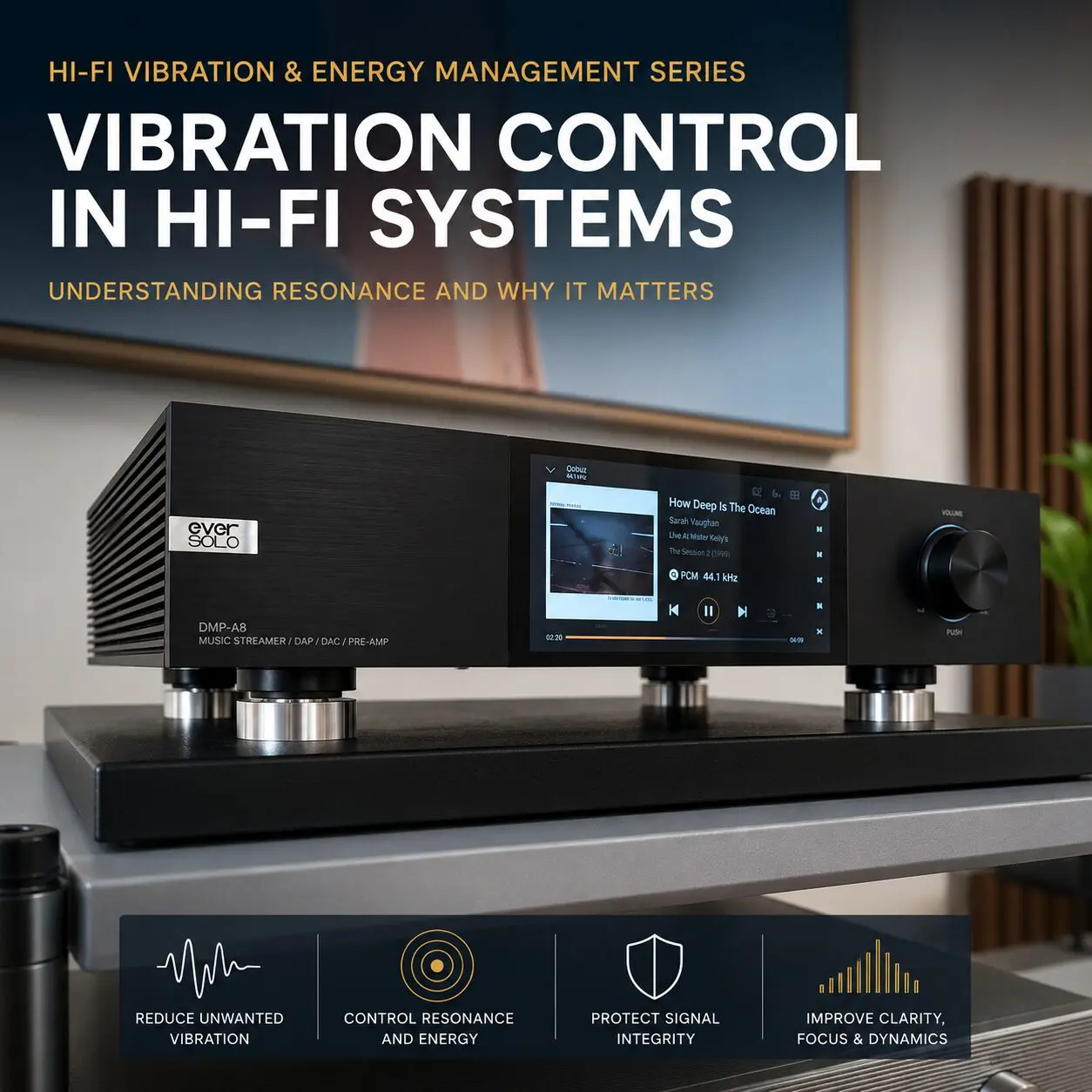
Part 1 of the Hi-Fi Vibration & Energy Management Series
Author/s: Bill Kotsakidis, Jim Kotsakidis
Author’s Note: The concepts discussed in this series have directly influenced the development of several Diamond Audioworks vibration management products, including isolation footer systems and speaker footers. Practical examples and measurements will be presented in later parts of this series.
Introduction
When audiophiles discuss improving their systems, the conversation usually revolves around better DACs, amplifiers, cables, or speakers. Yet one of the most overlooked aspects of achieving truly high-fidelity sound reproduction is vibration control.
Mechanical vibration exists in every audio system. It is generated by components within the system and by the environment around it. Left unmanaged, these vibrations can introduce subtle distortions that affect clarity, timing, imaging, and tonal balance.
This article is the first in our Hi-Fi Vibration & Energy Management series, where we explore the science behind resonance and vibration control and explain why managing mechanical energy is essential for extracting the best performance from your audio system.
What is Hi-Fi Vibration Control?
Hi-Fi vibration control is the process of managing unwanted mechanical energy within an audio system.
The goal isn’t necessarily to eliminate all vibration—that would be impossible. Instead, the objective is to:
- Reduce harmful resonances.
- Prevent external vibrations from entering sensitive components.
- Control the flow of mechanical energy through the system.
- Preserve the original audio signal as accurately as possible.
Proper vibration management can lead to improvements in:
- Soundstage and imaging
- Instrument separation
- Bass definition
- Midrange clarity
- Perceived dynamics
- Listening fatigue
However, vibration control is only one piece of the puzzle.
Other factors that significantly affect sound quality include:
- Electrical distortion
- Equipment matching
- Room acoustics
- Speaker positioning
- Power quality
- System setup
Every aspect of a Hi-Fi system works together to determine the final listening experience.
What is Distortion?
For the purposes of this discussion, distortion can be defined as:
Any deviation from the original signal.
This includes:
- Frequency response errors
- Amplitude changes
- Phase shifts
- Timing inaccuracies
- Harmonic distortion
- Mechanical coloration
Most audiophiles immediately think of electrical distortion, but mechanical vibration can also alter the signal in surprising ways.
Even extremely small vibrations can influence the behaviour of electronic components and subtly change the way we perceive music.
Understanding Resonance
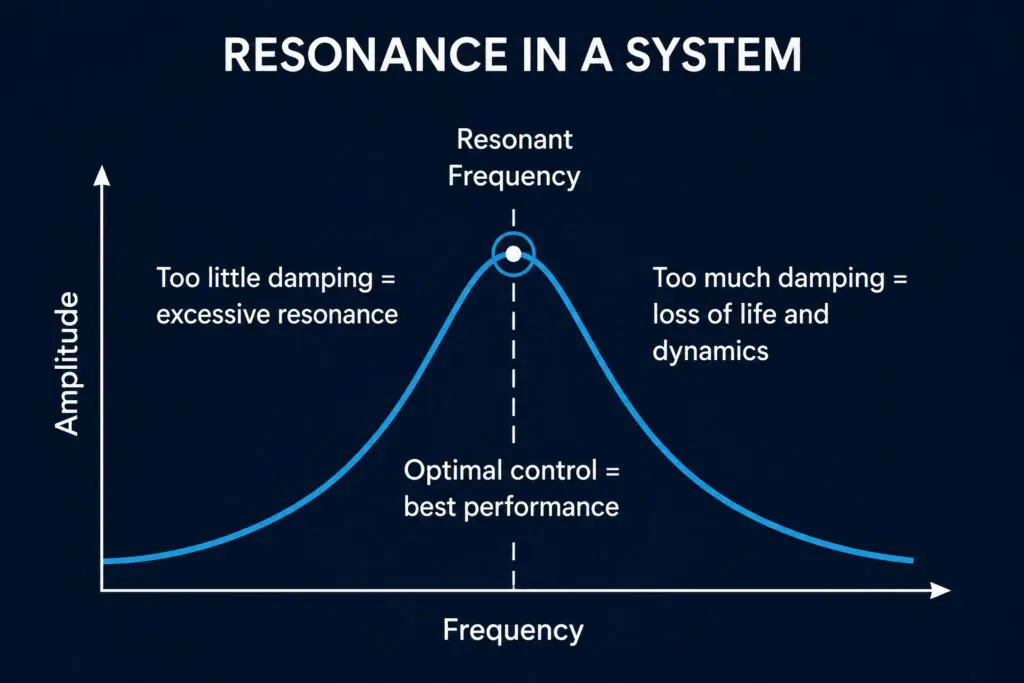
Every physical object has natural resonant frequencies.
Resonance occurs when a system stores and releases energy most efficiently, producing maximum movement with minimal input energy.
The resonant behaviour of an object depends on:
- Mass
- Stiffness
- Material composition
- Geometry
- Damping characteristics
Everything in your audio system has resonances, including:
- Speakers
- Equipment racks
- Amplifier chassis
- Transformers
- Circuit boards
- Capacitors
- Turntables
- Furniture
- Floors
- Even the listening room itself
The challenge isn’t eliminating resonance entirely.
The challenge is understanding which resonances are harmful and how to control them.
Why Resonance Matters in Hi-Fi Systems
Mechanical energy can influence sound reproduction in several ways.
Examples include:
Transformer Vibration
Power transformers naturally vibrate due to magnetic forces. This energy can travel through the chassis and into other components.
Loudspeaker Energy
Speakers generate substantial amounts of mechanical energy that can excite floors, racks, and nearby equipment.
Component Microphonics
Certain components can respond to vibration by generating small electrical signals, effectively becoming microphones.
Structural Resonance
Equipment racks and furniture can store and release energy at specific frequencies, adding unwanted coloration to the sound.
The cumulative effect of these vibrations can be surprisingly audible.
Not All Resonances Should Be Eliminated
One of the biggest misconceptions in audio is that all resonance is bad.
This simply isn’t true.
Over-damping a system can result in sound that is:
- Flat
- Lifeless
- Dynamically constrained
- Less engaging
On the other hand, insufficient control can lead to sound that is:
- Harsh
- Bright
- Bloated
- Unfocused
The objective is not maximum damping.
The objective is controlled energy management.
Understanding how mechanical energy flows through your system is the key to determining the best vibration control strategy.
Where Does Vibration Come From?
Vibrations in a Hi-Fi system come from two primary sources.
External Sources
- Foot traffic
- Building vibrations
- Traffic outside the home
- HVAC systems
- Acoustic feedback from speakers
- Room resonances
Internal Sources
- Power transformers
- Cooling fans
- Disc transports
- Turntable motors
- Loudspeaker drivers
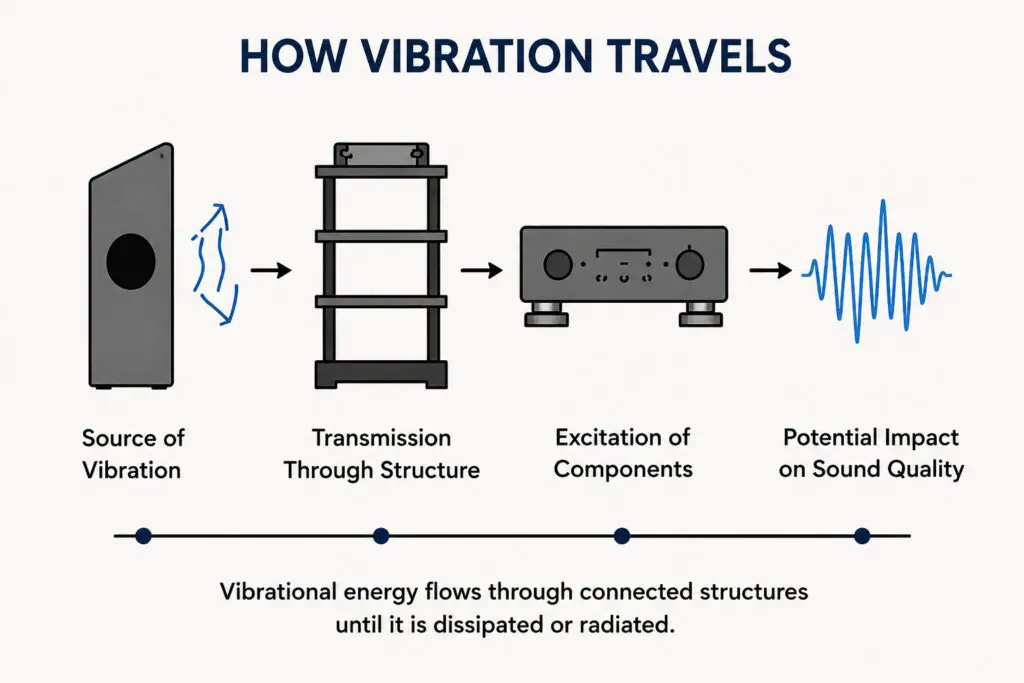
Many components are both:
Vibration Generators
and
Vibration Receivers.
For example, an amplifier’s transformer generates vibration, while the amplifier chassis can simultaneously receive vibration from the speakers and equipment rack.
Understanding this relationship is critical when selecting the right vibration control solution.
The Three Principles of Vibration Control
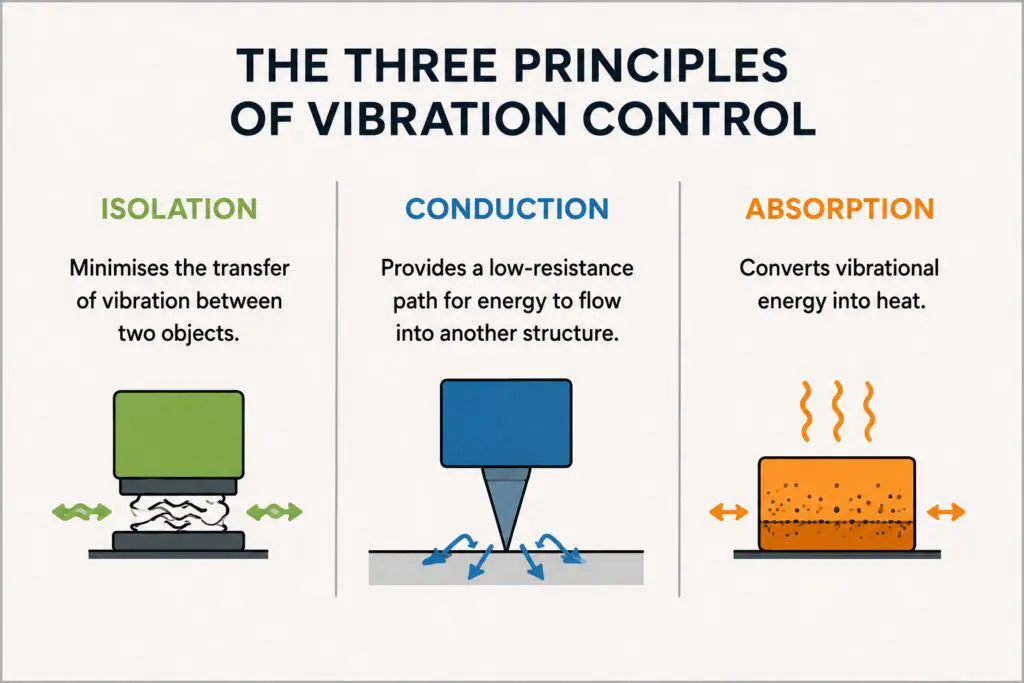
Almost every vibration control product operates using one or more of these principles:
1. Isolation
Isolation attempts to reduce the transfer of vibration between two objects.
Examples include:
- Elastomers
- Springs
- Viscoelastic materials
- Air suspension systems
The goal is to prevent unwanted energy from reaching sensitive equipment.
2. Conduction
Conduction attempts to provide a low-resistance path for mechanical energy to flow from one object into another.
Examples include:
- Metal spikes
- Cones
- Rigid couplers
The effectiveness of this approach depends heavily on the materials involved and the structure receiving the energy.
3. Absorption
Absorption converts vibrational energy into heat.
Examples include:
- Viscoelastic materials
- Constrained-layer damping
- High-mass structures
- Composite materials
Absorption can be extremely effective, but excessive damping can also remove desirable energy from the system.
There Is No Universal Solution
This is why vibration control products often produce different results in different systems.
Every system is unique.
Different components generate different vibration spectra.
Different rooms behave differently.
Different racks have different resonant characteristics.
The best results come from understanding the problem and applying the appropriate solution for each component.
Why We Believe Energy Management Matters
At Diamond Audioworks, we have spent countless hours evaluating how mechanical energy influences system performance.
Our experience has shown that managing vibration correctly can unlock significant improvements in clarity, focus, and musical engagement.
As this series progresses, we’ll explore practical applications of vibration control and examine how different approaches can be used to manage the unique challenges presented by source components, amplifiers, and loudspeakers.
Coming Up in Part 2
In the next article, we’ll examine:
How Vibrations Travel Through Equipment Racks and Furniture
We’ll explore why equipment support systems play such an important role in sound quality and why different components often require entirely different approaches to vibration management.
References
- Harris, C.M. and Piersol, A.G., Harris’ Shock and Vibration Handbook, McGraw-Hill.
- Rao, S.S., Mechanical Vibrations, Pearson Education.
- Cremer, L., Heckl, M. and Petersson, B.A.T., Structure-Borne Sound, Springer.
- Toole, F.E., Sound Reproduction: The Acoustics and Psychoacoustics of Loudspeakers and Rooms, Routledge.
- Rossing, T.D., The Science of Sound, Addison-Wesley.
- Nashif, A.D., Jones, D.I.G. and Henderson, J.P., Vibration Damping, John Wiley & Sons.
- AES Technical Papers on structural resonance, mechanical feedback and microphonic effects in audio systems.