
Sub-Total: $0.00
Audiophile Switch Showdown: LHY Audio AS6 vs Gustard N18 Pro

Two Audiophile Network Switches Put Head-to-Head in a High-End Streaming System
Author: Jim Kotsakidis
Audiophile network switches continue to spark debate in the HiFi world.
Some listeners swear by them. Others remain skeptical that a network switch could meaningfully influence sound quality in a digital streaming system.
Recently, we had the opportunity to directly compare two popular audiophile switches — the Gustard N18 Pro and the LHY Audio AS6 — in a revealing high-end setup alongside one of our customers who brought his own N18 Pro in specifically for comparison testing.
What followed turned into one of the more interesting listening sessions we’ve had in recent months.
Price Comparison – Gustard N18 Pro vs LHY Audio AS6
One of the first things worth discussing is the price difference between these two switches.
Gustard N18 Pro
- Approximate Australian pricing: $850 AUD
LHY Audio AS6
- Approximate Australian pricing: $1399 AUD
That’s a meaningful jump in cost.
And naturally, the question becomes:
Does the AS6 justify the additional investment?
To answer that properly, we first need to look at what both products are actually trying to achieve.
Why Audiophile Network Switches Exist
Modern digital streaming systems are extremely sensitive to electrical noise.
Even though Ethernet data itself is packet-based and error corrected, noise travelling through grounding systems, power supplies, clocks, and network hardware can still influence downstream audio components — particularly highly resolving DACs and streamers.
This is where audiophile switches focus their engineering:
- Noise suppression
- Clock stability
- Isolation
- Cleaner power delivery
- Reduced EMI and RFI contamination
And on paper at least, both the Gustard N18 Pro and LHY Audio AS6 target very similar goals.
Gustard N18 Pro Features
The Gustard N18 Pro offers an impressive feature set for its price point.
Key Features
- 1 × SFP fibre port
- 5 × Gigabit Ethernet ports
- Isolated copper Ethernet port
- Support for external 10MHz master clocks
- Audio-specific internal transformer
- Multi-stage filtering and voltage regulation
- Multi-way isolated power supply design
- SFP optical isolation capability
- Designed specifically for audio streaming systems
One interesting point, however, is that Gustard doesn’t clearly specify the exact internal clock architecture used inside the N18 Pro itself.
The external 10MHz clock input is certainly attractive for enthusiasts looking to experiment with master clock synchronization, but the internal clock implementation remains somewhat unclear from the published specifications.
LHY Audio AS6 Features
The LHY Audio AS6 takes a more overtly reference-grade approach in both construction and design philosophy.
Key Features
- High-end Ethernet switch with integrated OCXO reclocking
- Ultra-low-noise multistage linear power supply
- Measurable microvolt-level noise performance
- CNC aluminium chassis
- Noratel toroidal transformer
- UK RIFA AC noise suppression filtering
- 4 × Gigabit Ethernet ports
- 1 × Isolated Gigabit Ethernet port
- 1 × SFP fibre port
- 10MHz master clock input
- SC-CUT OCXO clock design
- Phase noise specification of -100dBc/Hz typical
Both switches clearly place heavy emphasis on isolation and noise suppression architecture.
The Gustard N18 Pro includes both SFP optical isolation capability and an isolated copper Ethernet port, while the AS6 combines isolated network architecture with a highly refined OCXO reclocking implementation and ultra-low-noise internal linear power supply design.
So on paper, both products are clearly engineered for serious audiophile streaming systems.
The real question was how those engineering approaches translated into actual listening performance.
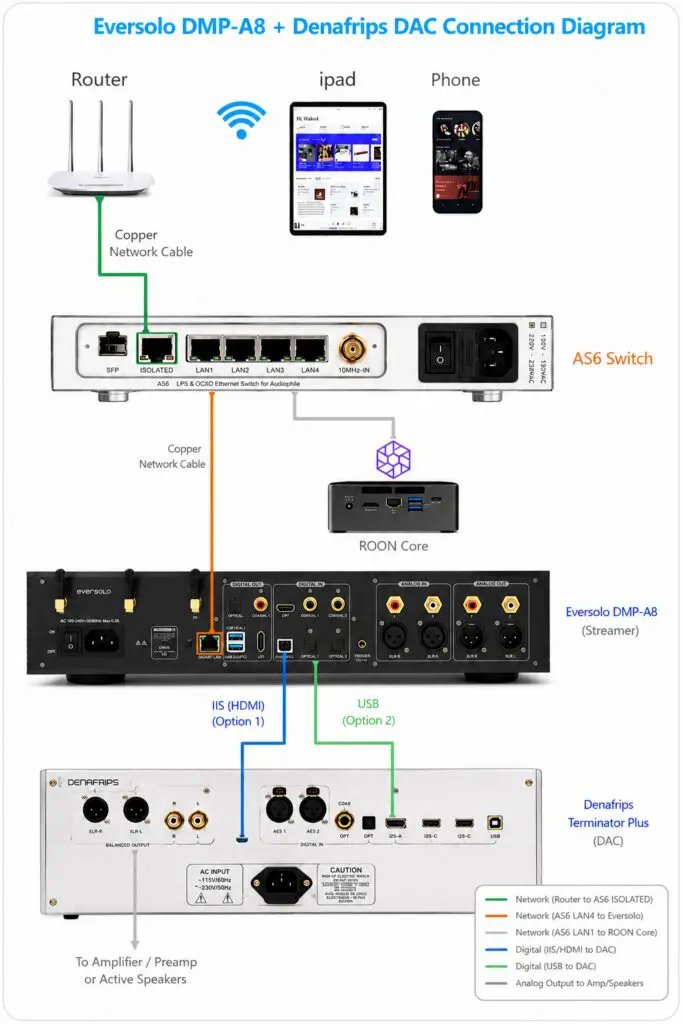
Test Setup
For testing, both switches were evaluated in the exact same streaming chain.
System Configuration
- Router powered by an LHY Audio LPS80 linear power supply
- Router connected via Cat7 Ethernet cable into the isolated port of the switch under test
- Intel NUC running ROON Core connected via copper Ethernet
- Eversolo DMP-A8 streamer connected via copper Ethernet
- Denafrips Terminator Plus DAC
- Reference amplification and loudspeaker system
Both switches were tested using identical downstream hardware and listening conditions to ensure consistency.

First Impressions
Straight away, both switches demonstrated clear improvements over standard consumer networking hardware.
The system sounded cleaner, smoother, and more composed overall compared to generic off-the-shelf switches.
The Gustard N18 Pro in particular performed well initially, presenting music with good clarity and respectable refinement.
Given its pricing and feature set, it’s easy to understand why the N18 Pro has gained popularity among audiophile streaming enthusiasts.
But as we moved deeper into familiar reference tracks, the differences between the two units started becoming more noticeable.
Listening Impressions – Gustard N18 Pro vs LHY Audio AS6
We spent some time listening across a range of material, and the differences became quite apparent fairly quickly.
The Gustard presented with a noticeably heavier bass profile, which at first can come across as impactful, but over longer listening it felt somewhat over-emphasised and less controlled.
More importantly, this seemed to come at the expense of overall tonal balance — the mids and treble were somewhat suppressed, which reduced clarity and air in the presentation.
In contrast, the AS6 delivered a much more cohesive and natural sound.
The bass was still present and extended, but tighter and better integrated with the rest of the frequency range. The midrange was more open and expressive, allowing vocals and instruments to come through with greater realism, while the treble had better extension and detail without sounding harsh.
Another key difference was dynamics.
The AS6 felt more lively and engaging, with better transient response and a greater sense of energy and flow throughout the music.
The Gustard, by comparison, sounded flatter and less dynamic, which made the listening experience feel somewhat restrained.
To be fair, the Gustard did exhibit a very quiet, “black” background, which is something it does well. However, that alone wasn’t enough to compensate for the lack of balance and overall musical engagement.
Dire Straits – “You and Your Friend”
This track is excellent for evaluating spatial layering, guitar texture, and depth.
Through the Gustard N18 Pro, the presentation sounded controlled and clean, but slightly flatter front-to-back.
Bass weight was prominent, but some of the openness and air around instruments felt reduced.
Switching to the LHY Audio AS6 expanded the soundstage noticeably. Mark Knopfler’s guitar carried greater texture and realism, while instrument placement became easier to follow across the stage.
There was more dimensionality, more separation, and a stronger sense of realism overall.
Francine Thirteen – “Queen Mary”
This track revealed differences in vocal presentation and tonal balance almost immediately.
The Gustard delivered a respectable performance with good detail retrieval, but vocals sounded slightly more constrained and less holographic compared directly against the AS6.
The AS6 produced a fuller and more natural presentation with improved instrument separation and significantly better balance throughout the frequency range.
Bass remained controlled while vocals and ambient details became more expressive and easier to follow.
The presentation simply felt more complete.
Clark Terry – “Alternate One”
Jazz recordings tend to expose timing, harmonic decay, and spatial realism extremely well.
This was arguably where the largest gap appeared.
Through the AS6, brass instruments sounded more organic and dimensional, cymbals carried more natural decay, and the overall presentation felt significantly more effortless and dynamic.
The Gustard N18 Pro still sounded good especially considering its price but compared directly, it came across as comparatively flatter, heavier, and less engaging emotionally.
The AS6 simply allowed the system to breathe more naturally.
Why Did the AS6 Perform Better?
This is where implementation likely matters more than raw specifications alone.
The AS6 appears to place enormous emphasis on:
- Clock precision
- Ultra-low-noise power delivery
- Electrical isolation
- Noise suppression architecture
- Output stage refinement
The integrated SC-CUT OCXO reclocking implementation may also play a major role in improving timing precision and lowering perceived jitter throughout the digital chain.
Combined with its OCXO reclocking implementation, ultra-low-noise power design, and overall refinement of the isolated network architecture, the AS6 consistently sounded more refined, spacious, dynamic, and natural throughout our testing.
Importantly, none of these differences felt exaggerated or artificially “HiFi.”
Instead, the AS6 simply made music sound more believable and emotionally engaging.
Final Thoughts – Is the AS6 Worth the Extra Cost?
The Gustard N18 Pro remains a strong value proposition in the audiophile networking space.
At around $850 AUD, it offers meaningful improvements over standard consumer networking hardware and includes several advanced features typically not found at that price point.
But in a highly resolving streaming system, the LHY Audio AS6 ultimately operated at a higher level.
The improvements weren’t subtle:
- Better tonal balance
- Larger soundstage
- More realistic imaging
- Improved dynamics
- Fuller and more natural vocals
- Better bass integration and control
- More openness and detail retrieval
- Greater musical engagement
Most importantly, the AS6 consistently made listening sessions feel more natural and emotionally involving.
The customer who brought the Gustard N18 Pro in for comparison came away extremely impressed with how complete and refined the AS6 sounded in direct comparison.
So hopefully for us… that translates into a purchase.