
Sub-Total: $0.00
Reiki Audio OpticalBridge X Review: A Different Approach to Fibre Network Isolation
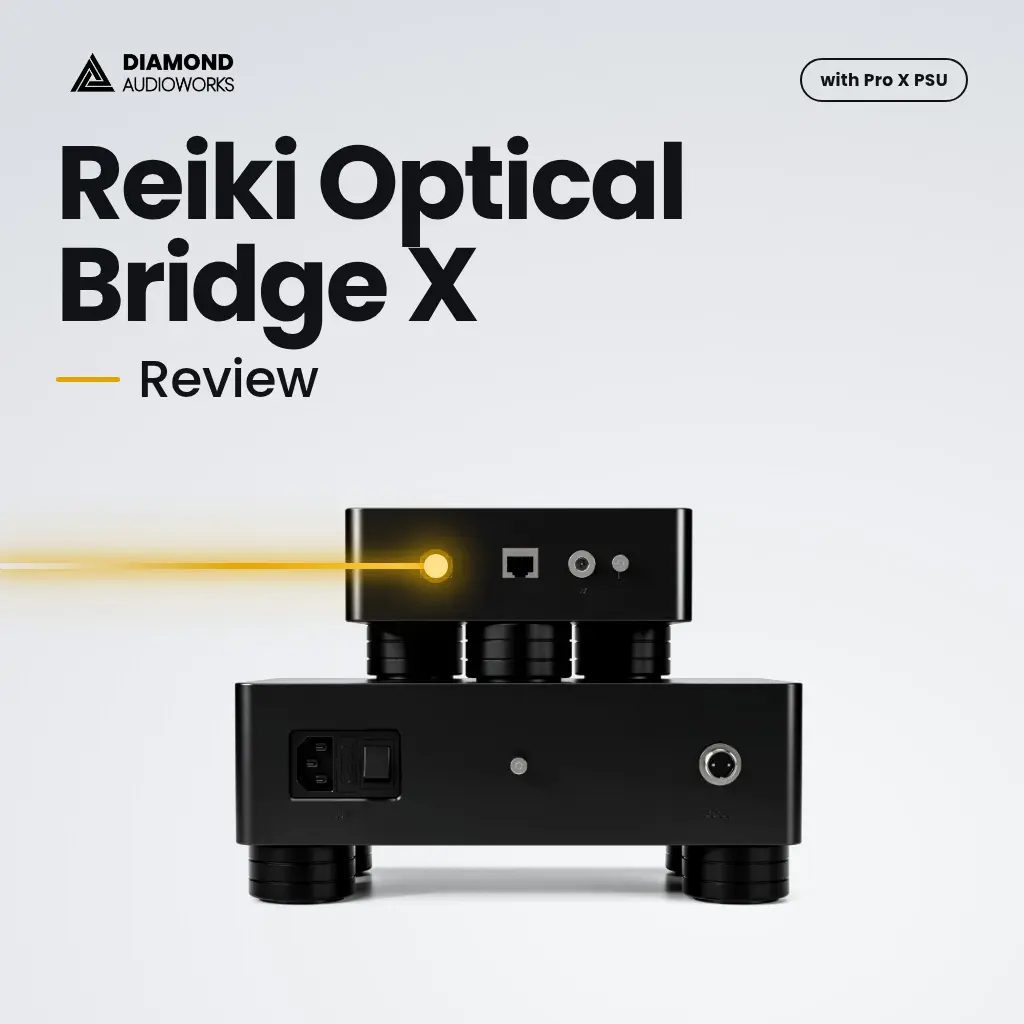
When Fibre Isolation Becomes Part of the Digital Front End
Author: Jim Kotsakidis
In our earlier review of the LHY Audio FMC, we looked at the benefits of using fibre in a high-end streaming system.
The concept is simple.
Ethernet carries digital data, but it also creates an electrical connection between network devices. A fibre link breaks that electrical path. The data continues to travel, but the electrical connection does not.
This can help isolate the audio system from noise generated elsewhere on the network.
Our experience with the LHY FMC showed us how effective this approach can be.
It also raised another question.
Can two products using the same basic fibre conversion principle sound different?
To find out, we compared the Reiki Audio OpticalBridge X with Pro X PSU directly against the LHY Audio FMC.
The comparison was performed in the same system and under the same conditions.
We used the same optical transceivers and the same fibre cable with both products.
The result surprised us.
The Reiki Audio OpticalBridge X produced a presentation that we found more detailed, more spacious and more holographic. It also gave us a stronger sense of separation between individual performers.
Most importantly, these differences were easy to hear in our reference system.
From the LHY FMC to the Reiki OpticalBridge X
The LHY Audio FMC was our starting point.
It is a compact and highly engineered fibre media converter designed for high-performance digital systems.
Its main features include:
- 10/100/1000Mbps Ethernet
- Isolated RJ45 input
- SFP optical output
- Three channels of LT3042 + PNP regulation
- OCXO clock
- Machined aluminium chassis
The LHY FMC is a very effective way to introduce fibre isolation into a streaming system.
That was clear from our original review.
The Reiki OpticalBridge X takes a different approach.
Rather than treating the fibre converter as simply another network component, Reiki has designed it as a complete digital front-end product.
The bridge circuitry, power supply, SFP, chassis and mechanical isolation are all part of the design.
This difference in philosophy became important when we began listening.
Two Different Design Philosophies
Both products perform the same basic task.
The network connection enters through Ethernet.
The signal is converted to optical.
It then travels through fibre before being converted back to Ethernet for the streamer.
The fibre connection provides the galvanic separation between the network and the audio system.
Where the products differ is in the way they implement the conversion.
The LHY FMC focuses on a compact design.
It combines an isolated Ethernet interface, SFP interface, precision clocking and regulated power in a machined aluminium chassis.
The Reiki OpticalBridge X takes a more holistic approach.
The bridge, power supply, SFP transceiver, mechanical construction and vibration control are all treated as parts of the same digital system.
Reiki Audio OpticalBridge X
The OpticalBridge X uses a 10mm milled and ceramic-coated aluminium case.
The construction feels more like a high-end audio component than conventional networking equipment.
Inside is Reiki’s audiophile-quality FMC circuitry.
The unit provides a Gigabit Ethernet port and an SFP optical interface.
Reiki has also selected the SFP transceiver with the audio application in mind.
Other design features include:
- Silver-plated OFC internal wiring
- PTFE insulation
- 4mm grounding post
- External Pro X linear power supply
- Stack Audio Auva isolation feet
- No LEDs
- No pinholes
- 1m single-mode optical cable
- 1m CAT6 Ethernet cable
The absence of LEDs is worth mentioning.
There are no unnecessary indicators or displays on the front of the unit.
The OpticalBridge X is designed to do one job and stay out of the way.
The Pro X Power Supply
The external power supply is an important part of the Reiki design.
The Pro X PSU is an upgraded version of Reiki’s fully linear Pro PSU.
It uses a matching 10mm aluminium enclosure.
The transformer is also 25% larger than the transformer used in the standard Pro PSU.
Reiki describes the design as a low-impedance power supply using high-quality components.
The goal is clean and stable DC power with low ripple and low noise.
The Pro X includes:
- 25% larger Audio Grade transformer
- Low-impedance design
- High-quality components
- Custom low-noise circuitry
- 10mm aluminium top plate
- Milled aluminium case
- No LEDs
- Matching isolation-foot options
The physical construction is also interesting.
The OpticalBridge X has a copper-lined 10mm aluminium base plate.
The Pro X has a 10mm aluminium top plate.
When the two units are used together, the bridge and power supply are physically separated by copper and aluminium.
This is another example of Reiki treating the bridge and PSU as one complete system.
The Listening System
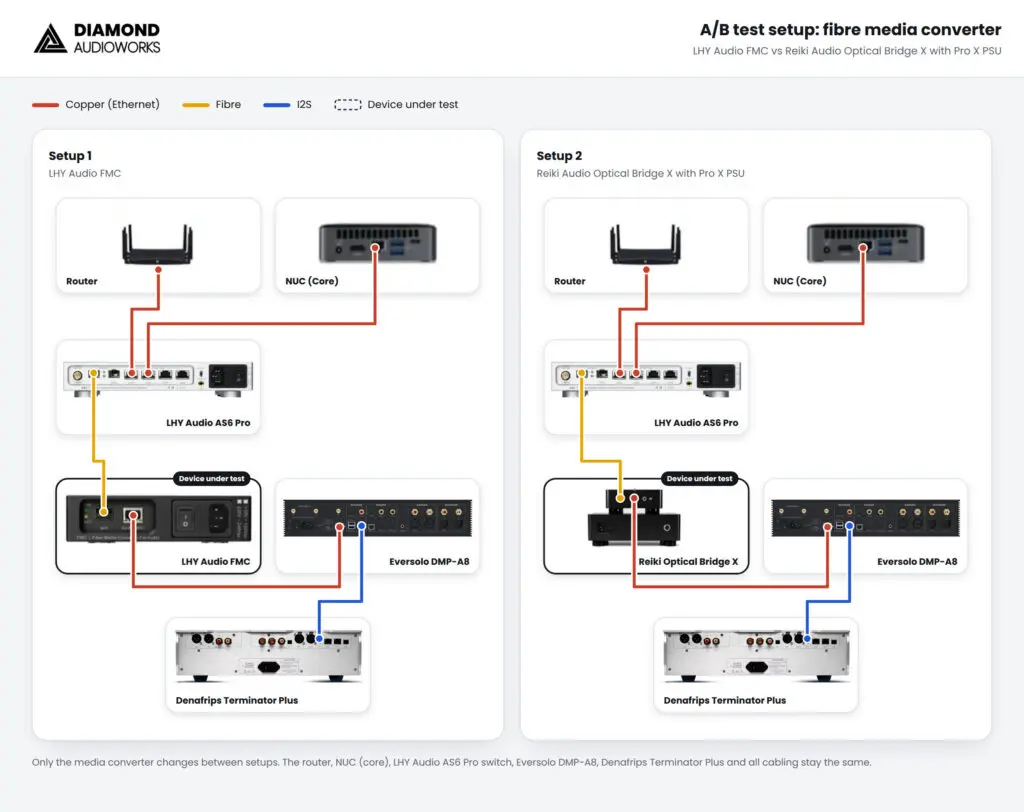
We kept the system as consistent as possible for the comparison.
The network path was:
Router → LHY AS6 Pro → Fibre → OpticalBridge/FMC → Copper → Eversolo DMP-A8
The LHY AS6 Pro remained in the system for both comparisons.
The Eversolo DMP-A8 also remained unchanged.
Its upgraded power supply was used throughout.
The most important point was the optical connection.
We used the same optical transceivers and the same fibre patch cable with both products.
This removed two obvious variables from the comparison.
The only major change was the fibre bridge itself.
We then listened to the two products back-to-back.
First Impressions: A Blacker Background
The first difference we noticed with the Reiki was the background.
The presentation seemed quieter.
In high-end audio, this is often described as a “blacker background”.
That description fitted what we heard.
Individual sounds seemed to emerge from a quieter space.
Low-level information was easier to follow.
The sound also felt less congested when several instruments were playing at once.
Importantly, the Reiki did not simply sound brighter.
The additional detail was not the result of adding more treble energy.
Instead, existing information seemed easier to hear.
That included small ambient cues, instrument decay and subtle spatial information.
More Detail Without More Brightness
This was one of the most interesting aspects of the comparison.
The Reiki did not sound more detailed because it pushed the treble forward.
Instead, the additional detail appeared to come from better separation.
Small sounds became easier to follow.
The decay of instruments was more apparent.
Room ambience was easier to hear.
Vocals had more information around them.
This gave the presentation a more relaxed quality.
At the same time, it allowed us to hear deeper into the recording.
That combination was one of the main reasons we preferred the Reiki in our system.
Dire Straits – “You and Your Friend”
Our first reference track was Dire Straits – “You and Your Friend”.
This recording is particularly useful for evaluating depth and spatial information.
The LHY FMC already produced a wide and convincing soundstage.
There was good separation between the instruments.
The Reiki OpticalBridge X took the presentation further.
The first thing we noticed was greater depth.
The soundstage appeared to extend further behind the loudspeakers.
Individual instruments also seemed to occupy more clearly defined positions.
The ambience of the recording became easier to hear. In particular the drum snare had more decay.
There was a stronger sense of the acoustic environment surrounding the performers.
This created a more three-dimensional presentation.
The soundstage did not simply become larger.
Instead, there appeared to be more information defining the existing space.
That gave the music a more holographic quality.
A More Holographic Presentation
“Holographic” is a word that is often used in high-end audio.
In this case, we use it to describe the improved separation between sounds and the space around them.
With the Reiki, instruments and voices appeared to have greater separation from their surroundings.
The spaces between individual sounds were easier to perceive.
There was also a stronger sense of front-to-back layering.
This was particularly obvious with recordings containing natural ambience.
The recording already contained this information.
Our impression was that the Reiki made it easier to perceive.
Reese Wynans & Friends – “Sweet Release”
The second reference track provided an even more obvious example.
Reese Wynans & Friends – “Sweet Release” features multiple vocalists.
That makes it a useful track for evaluating image separation and acoustic space.
With the LHY FMC, the singers were clearly positioned.
The soundstage was well organised.
However, switching to the Reiki made the separation more obvious.
Each individual singer seemed to occupy a more clearly defined acoustic space.
There was more air around each voice.
The position of each performer appeared more distinct.
Rather than hearing several voices within one broad soundstage, we had a stronger impression of the individual spaces around them.
The boundaries between the performers were more pronounced.
This was one of the most convincing differences we heard.
The LHY remained clear.
The Reiki made the space between the performers easier to hear.

The Importance of Space
One of the recurring impressions was the sense of space around individual sounds.
This is difficult to measure through listening alone.
However, it is easy to recognise when it changes.
A high-resolution system can reveal the acoustic information surrounding a performer.
When that information is clearly reproduced, the soundstage can feel deeper and more three-dimensional.
The Reiki gave us more of that impression.
Individual sounds appeared to have more room around them.
The presentation also felt less crowded.
This contributed to the stronger holographic effect we heard.
Fibre Does More Than Separate the Network
Our original LHY FMC review focused heavily on fibre isolation.
That remains the fundamental reason to consider an optical bridge.
A typical home network may include:
- Router
- Wi-Fi equipment
- Network switches
- NAS devices
- Computers
- Modems
- Networked power supplies
All of these devices exist within the same electrical environment.
Fibre creates a physical break in that connection.
The digital data continues to travel.
The electrical connection does not.
This is one reason fibre is so interesting for high-end digital audio.
However, our comparison suggests that the bridge itself also deserves attention.
The power supply, clocking, SFP transceiver, internal wiring and mechanical design can all form part of the implementation.
LHY FMC vs Reiki OpticalBridge X
The most interesting part of this comparison was not the basic fibre conversion itself.
Both products use fibre to break the electrical connection between the network and the audio system. The real question was what happens when the noise floor around that conversion is reduced further.
In our listening, this was where the Reiki began to pull away from the LHY.
Digital audio can contain enormous amounts of information at very low levels. Room ambience, instrument decay, reverberation, the resonance of a guitar string and the small acoustic cues around a vocalist can all contribute to our perception of space and realism.
When the background becomes quieter, these low-level cues become easier to distinguish.
That was exactly what we heard with the OpticalBridge X.
The Reiki did not simply make the presentation louder or brighter. Instead, it seemed to remove a layer of low-level haze that was masking some of the information around the music.
With less apparent noise surrounding the signal, individual sounds became easier to separate.
This had several consequences.
The soundstage became more organised.
Images became more precisely defined.
There was greater separation between performers.
Small details that had previously been present but less obvious became easier to hear.
Most importantly, the additional information was not presented as an artificial increase in treble or edge definition. It appeared as greater resolution within the existing recording.
This is where the different design philosophies between LHY and Reiki became apparent.
The LHY FMC is a highly engineered solution that focuses on providing effective electrical isolation, precision clocking and clean regulated power in a compact package.
It does this extremely well.
The Reiki takes the same fundamental principle and pushes the optimisation further around the conversion stage. The power supply, mechanical construction, SFP implementation, internal wiring and physical isolation are all treated as important parts of the final result.
In our system, that broader approach translated into something we could hear.
The quieter background allowed more of the recording’s low-level information to emerge.
That, in turn, improved our perception of space, depth and image separation.
It is an important distinction.
We are not suggesting that the Reiki creates information that wasn’t present in the recording.
Rather, our impression was that it allowed more of the information already there to come through without being masked by the surrounding noise and complexity of the digital environment.
This was ultimately the biggest difference between the two products.
The LHY gave us the benefits of fibre isolation.
The Reiki gave us those benefits while taking the presentation further in terms of resolution, separation and spatial information.
Is the Reiki Better?
Having spent considerable time with the LHY FMC, we were already convinced that it was an excellent product.
The Reiki OpticalBridge X changed our view of just how far this part of the digital front end could be taken.
In our system, yes — we believe the Reiki OpticalBridge X is the better performer.
The difference was not simply a change in tonal balance.
It was a more fundamental improvement in the way the recording was presented.
The background was quieter.
Low-level detail was easier to hear.
Images were more precisely located.
The spaces between performers were more obvious.
Depth increased.
The overall soundstage became more three-dimensional.
Most importantly, the Reiki allowed us to hear things in familiar recordings that were either less obvious or effectively masked when using the LHY FMC.
That is a significant result.
However, there is an equally significant qualification.
The Reiki costs considerably more.
That additional cost is not simply paying for a different Ethernet-to-fibre converter.
You are buying a much more substantial overall implementation.
The OpticalBridge X has a substantial 10mm milled aluminium chassis, ceramic-coated finish and copper-lined base.
The Pro X PSU uses its own substantial 10mm aluminium enclosure and a larger Audio Grade transformer.
The bridge and PSU are designed as a matched system.
The internal construction, power supply design, selected SFP and mechanical isolation all reflect the same philosophy.
Even the physical separation between the bridge and power supply is part of the design.
The result feels more like adding another high-end audio component to the rack than adding a network accessory.
And that is ultimately how we would position the Reiki.
The LHY FMC is an exceptionally capable way of introducing fibre isolation into a digital system.
It offers a very strong combination of performance, engineering and practicality.
The Reiki OpticalBridge X is a step further.
It takes the same fundamental concept and applies a much more uncompromising approach to the implementation.
In a resolving system, we believe that difference is audible.
Whether it is worth the additional investment will depend on the rest of the system.
But if the goal is to extract the maximum possible performance from the network side of a high-end digital front end, the Reiki deserves serious consideration.
We would not replace the LHY with the Reiki because the LHY is deficient.
We would replace it because the Reiki does more.
Why the Same Fibre Cable Matters
We consider this an important part of the comparison.
Both products used the same optical transceivers.
Both products used the same fibre cable.
The same LHY AS6 Pro was used upstream.
The same streamer was used downstream.
The rest of the system remained unchanged.
This allowed us to focus on the difference between the two optical bridges.
It does not make the test a scientific measurement.
However, it removes several obvious variables.
That makes the comparison more useful from a practical listening perspective.
Where the OpticalBridge X Fits
The OpticalBridge X is aimed at the enthusiast who wants to take network optimisation further.
If the goal is simply to introduce fibre into a streaming system, a basic media converter may be sufficient.
The Reiki is aimed at a different level of system.
It has been designed as a high-end audio component.
The enclosure is substantial.
The power supply is substantial.
The SFP is carefully selected.
Mechanical isolation is included.
The bridge and PSU are designed to work together.
For a modest streaming system, the additional investment may not be worthwhile.
In a highly resolving system, however, the difference may be much easier to appreciate.
Optimising the Digital Front End
The OpticalBridge X also fits into a wider approach to digital audio.
A modern streaming system contains several interfaces.
The network connection is one.
USB is another.
Clocking is another.
Power supplies are another.
Each stage can be optimised independently.
That doesn’t mean every system needs more equipment.
It means each component should be evaluated on its own merits.
Our LHY FMC review demonstrated the potential of fibre isolation.
The Reiki comparison took that one step further.
It showed us that the implementation of the fibre interface can also influence the final presentation.
Our Verdict
Our original experience with the LHY FMC convinced us that fibre isolation could make a significant difference in a high-end digital system.
The Reiki OpticalBridge X took that experience to another level.
The comparison became particularly compelling when we returned to familiar recordings.
With Dire Straits – “You and Your Friend”, one of the first things we noticed was the guitar amplifier character in the opening sequence.
With the Reiki in place, the subtle distortion and texture of the guitar amplifier were much easier to hear.
It was not simply the guitar itself.
There was more information around the sound of the amplifier.
The texture of the distortion became more apparent, giving the guitar a more realistic sense of character and physical presence.
With the LHY FMC, that information was much less obvious.
The basic presentation remained very good, but the fine texture of the amplifier was not reproduced with the same clarity.
Another difference became apparent when listening to the snare.
When the drummer hits the edge of the snare, the Reiki allowed the decay to linger for longer.
You could follow the sound as it dissipated into the recording space.
The note did not simply stop after the initial transient.
The decay remained audible, helping to define the acoustic environment around the instrument.
That additional decay information contributed strongly to the sense of depth and realism.
The Reiki made the recording feel less like a collection of individual sounds and more like a performance taking place in a physical space.
The difference was equally compelling with Reese Wynans & Friends – “Sweet Release”.
This track provided one of the clearest demonstrations of the Reiki’s ability to separate individual performers.
With the OpticalBridge X, each singer was placed precisely within the soundstage.
Rather than simply hearing a group of voices spread across the left and right channels, we could pinpoint where each singer appeared to be standing.
Each voice occupied its own clearly defined acoustic space.
There was air around the individual performers, and the separation between them was easier to perceive.
The guitar was another revelation.
The resonance of the guitar strings was more apparent.
We could hear the individual character of the strings more clearly, including the subtle sound of the pick contacting the string.
These are extremely small details.
They are also the sort of details that contribute to the realism of a recording.
The LHY FMC reproduced the track very well.
But the Reiki allowed more of these low-level cues to emerge from the background.
That gave the performance a stronger sense of physical presence.
This is ultimately what impressed us most about the OpticalBridge X.
It did not simply produce more detail.
It produced more meaningful detail.
The additional information improved the sense of space, realism and separation rather than making the presentation sound artificially etched or bright.
The LHY Audio FMC remains an excellent performer and continues to offer a very effective route into fibre isolation.
But when the two were compared directly in our system, the Reiki OpticalBridge X consistently gave us the presentation we preferred.
The difference came at a cost.
The Reiki is a considerably more substantial investment than the LHY.
But it also represents a considerably more comprehensive approach to the problem.
The build quality is excellent throughout.
The machining, enclosure thickness, external power supply, transformer, copper-lined base, mechanical isolation and overall construction all feel appropriate for a high-end audio component.
It is clear that Reiki has not simply taken a conventional media converter and placed it inside a nicer box.
The entire product has been designed around the goal of creating a quieter and more controlled digital interface.
And in our system, we believe that approach worked.
The LHY FMC showed us the value of fibre isolation.
The Reiki OpticalBridge X showed us what can happen when that concept is taken further.
For us, the result was a quieter background, more precise imaging, greater spatial separation, more convincing decay and significantly more low-level information.
The most telling part was that these differences became apparent in recordings we already knew extremely well.
That is when an upgrade becomes difficult to dismiss.
For our system, the Reiki Audio OpticalBridge X with Pro X PSU is the clear winner.
It costs more.
It takes up more space.
But it also delivers a level of construction and performance that, in our view, justifies the additional investment in a genuinely high-resolution digital front end.red.
Final Thoughts
The most interesting conclusion isn’t simply that one product beat another.
It is that implementation matters.
The LHY Audio FMC demonstrates what can be achieved with a compact design, precision clocking and sophisticated power regulation.
The Reiki Audio OpticalBridge X takes a different approach.
It combines the fibre bridge with a carefully selected SFP, substantial mechanical construction, external linear power, physical separation between the bridge and PSU, internal wiring choices and mechanical isolation.
In our system, we could hear the difference.
The change wasn’t a dramatic shift in tonal balance.
It wasn’t simply more treble or artificial detail.
Instead, the music seemed to have more space around it.
The background appeared quieter.
Images became more clearly defined.
Individual performers occupied more distinct acoustic spaces.
The overall presentation became more three-dimensional.
For us, the Reiki Audio OpticalBridge X with Pro X PSU is one of the more interesting network upgrades we have tried in a high-resolution digital system.
If the LHY FMC demonstrated why fibre isolation matters, the Reiki demonstrated that how the fibre interface is implemented can matter too.
For listeners who have already optimised their streamer, DAC and network infrastructure, the OpticalBridge X is a compelling next step to investigate.
System Used
Network: Router → LHY AS6 Pro
Fibre bridge: LHY Audio FMC / Reiki Audio OpticalBridge X + Pro X PSU
Optical connection: Same SFP transceivers and fibre cable
Streamer: Eversolo DMP-A8 with upgraded LHY Audio power supply
Listening method: Back-to-back comparison
Reference tracks:
- Dire Straits – You and Your Friend
- Reese Wynans & Friends – Sweet Release
Listening observations are based on our own system and preferences. They should not be interpreted as universal claims about the performance of either product.