
Sub-Total: $0.00
LHY Audio FMC Review: Why Fibre Optic Isolation Is the Next Step in High-End Digital Audio
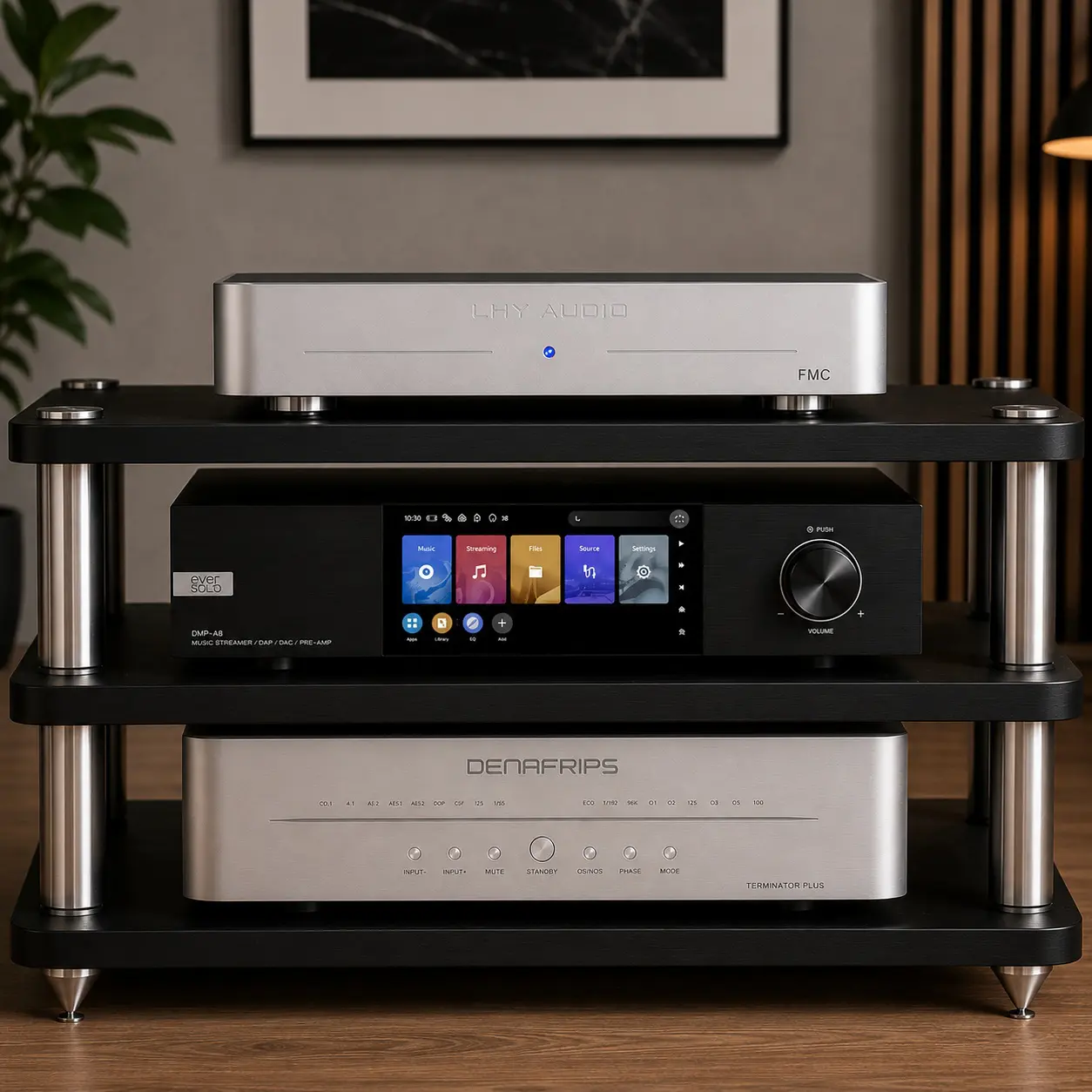
Why Adding Fibre Optic Isolation Between Your Network Switch and Streamer Can Transform Your System
Author: Jim Kotsakidis
As digital audio systems become increasingly revealing, enthusiasts are discovering that optimizing the network chain can yield surprisingly significant improvements in sound quality.
We’ve already explored the impact of upgrading from a standard network switch to dedicated audiophile switches like the LHY Audio AS6. But the next logical question is:
Can adding fibre optic isolation between the network switch and streamer take things even further?
Recently, we introduced the LHY Audio FMC (Fibre Media Converter) into our reference streaming setup, placing it between the LHY Audio AS6 and our Eversolo DMP-A8 streamer.
The results were immediate and, quite frankly, exceeded our expectations.
Test Setup
For this evaluation, we used the following signal chain:
- Router powered by LHY Audio LPS80 Linear Power Supply
- Copper Ethernet connection from router to the isolated input on the LHY Audio AS6
- Intel NUC running ROON Core connected to the AS6
- Fibre optic connection from the AS6 SFP port to the LHY Audio FMC
- Copper Ethernet connection from the LHY Audio FMC directly into the Eversolo DMP-A8
- I²S output from the Eversolo into the Denafrips Terminator Plus DAC
This effectively inserts a complete optical break between the network switch and the streamer.
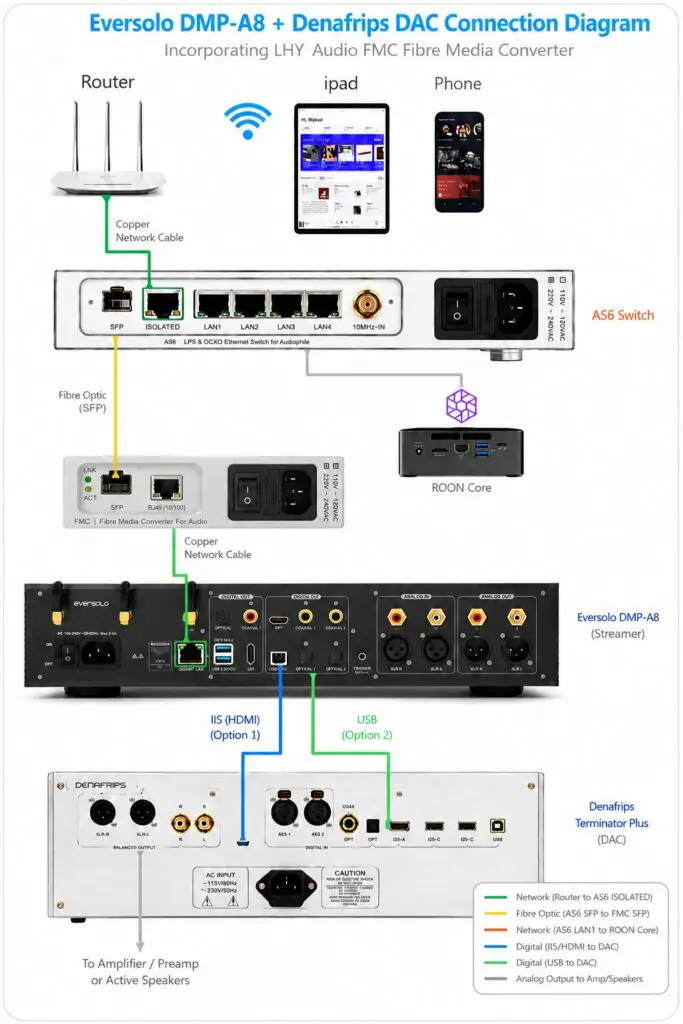
Note: In our reference system, the LHY Audio AS6 and Intel NUC running Roon Core are located in a separate equipment room from the main HiFi system. This allows the network infrastructure and computer hardware to be physically isolated from the listening environment, reducing the potential for mechanical and electrical noise.
The Intel NUC running Roon Core was also connected directly to the AS6 in the equipment room, ensuring all network traffic passed through the same low-noise network architecture.
What Is a Fibre Media Converter?
A fibre media converter (FMC) converts traditional copper Ethernet into optical fibre and then back again.
Unlike copper Ethernet cables, optical fibre transmits data using light rather than electrical signals.
This means that no direct electrical connection exists between the source and destination devices.
For high-performance audio systems, this offers one major advantage:
Complete Galvanic Isolation.
Why Does Galvanic Isolation Matter?
Every device connected to your home network introduces a certain amount of electrical noise.
Routers, switches, computers, NAS drives, televisions, switch-mode power supplies, and even household appliances can inject unwanted high-frequency noise into the network infrastructure.
While Ethernet data itself is error-corrected, the electrical noise riding alongside that data can potentially find its way into sensitive digital audio components.
Galvanic isolation completely breaks this electrical path.
By converting the signal into light, fibre optic transmission eliminates direct ground connections between devices and significantly reduces the opportunity for unwanted electrical noise to propagate through the system.
In theory, the streamer receives the same data—but in a much quieter electrical environment.
Our listening tests suggest that theory has real-world benefits.
First Listening Impressions
The first thing that struck us was an increase in overall clarity.
The background became even quieter, allowing subtle details to emerge more naturally from the recording.
Instrument delineation improved noticeably, making it easier to follow individual musicians within complex passages.
The soundstage also appeared more transparent, with a greater sense of space between performers.
Nothing felt artificially enhanced.
Instead, it simply sounded as though a very light veil had been removed from the presentation.
Improved Transient Performance
One of the biggest surprises was the improvement in transient attack.
Drum strikes carried greater impact and immediacy.
Snare hits had more snap.
Kick drums started and stopped with better definition.
Piano notes exhibited cleaner leading edges, while plucked strings gained additional texture and realism.
The system simply sounded faster and more responsive.
Music flowed with greater energy while remaining completely relaxed.
Reference Listening Tracks
Alison Krauss — It Doesn’t Matter
This track has become one of our favourite references for evaluating female vocals and microdynamics. Alison Krauss’ voice is beautifully recorded, with subtle inflections and delicate breath work that can easily become blurred if a system is struggling with low-level resolution.
With the LHY Audio FMC inserted into the chain, her vocals appeared more tangible and three-dimensional. There was greater separation between her voice and the accompanying instruments, creating a stronger sense of realism.
What impressed us most was the dynamic contrast. Soft passages emerged from an even darker background, allowing tiny vocal nuances to become more apparent. Rather than sounding artificially detailed, the presentation simply felt cleaner and more effortless.
Marcin — Toccata
Toccata is an incredibly demanding recording that combines rapid-fire acoustic guitar techniques, body percussion, and a wide variety of transient effects.
This track quickly revealed one of the FMC’s greatest strengths.
Individual guitar strikes had noticeably greater attack, while the countless percussive effects layered throughout the performance became easier to distinguish from one another. Harmonics, finger slides, and body taps all occupied their own space within the soundstage instead of blending together.
The overall presentation felt faster and more dynamic, with improved transient response giving the performance an added sense of excitement and realism.
The system simply sounded more alive.
Dominique Fils-Aimé — Birds
Birds is a beautifully recorded piece that showcases vocal layering, ambience, and spatial information.
The addition of the FMC brought a remarkable sense of openness to the recording. The layered vocals floated effortlessly within the soundstage, with improved separation between each individual voice.
Background textures and reverberation trails became easier to follow, helping to create a more immersive listening experience.
Perhaps the biggest improvement was the sense of air around the performance. The recording breathed more naturally, making it easier to forget about the equipment and simply enjoy the music.
Why Fibre Optic Isolation Can Improve Sound Quality
A common misconception is that fibre optic networking somehow changes the digital data itself.
It doesn’t.
The bits arriving at the streamer are identical whether they travel over copper or fibre.
The difference lies in the electrical environment surrounding the audio hardware.
Copper Ethernet cables provide a direct electrical connection between devices, allowing high-frequency noise and ground contamination generated by routers, computers, switches, and switch-mode power supplies to propagate through the network.
By converting the signal into light, fibre optic transmission completely breaks that electrical path through galvanic isolation.
While the data remains unchanged, the streamer and ultimately the DAC are exposed to significantly less unwanted electrical noise.
How Network Noise Can Affect DAC Performance
Modern DACs are extraordinarily sensitive devices.
Although the incoming digital data may be perfectly intact, unwanted electrical noise entering the streamer can potentially influence the surrounding circuitry responsible for clock generation, voltage regulation, and the analogue output stage.
High-performance DACs like the Denafrips Terminator Plus rely on extremely precise timing and exceptionally low-noise power rails to achieve their full potential. Any additional noise entering the system can increase the workload on those internal circuits.
Reducing electrical contamination before it reaches the streamer allows the DAC to operate in a cleaner environment.
The result isn’t different data—it’s often better clock stability, lower overall noise within the analogue stages, and a presentation that sounds more transparent, dynamic, and natural.
Based on our listening sessions, the LHY Audio FMC appears to do exactly that.
The improvements we heard—greater instrument separation, enhanced transient attack, increased vocal realism, and a more transparent soundstage—all point towards a quieter and more stable digital front end.
Is the LHY Audio FMC Worth It?
If you’re building a serious streaming system around components like the Eversolo DMP-A8, Denafrips Terminator Plus, or similar high-resolution digital front ends, the LHY Audio FMC is one of the more impressive upgrades we’ve recently tried.
Unlike some tweaks that require extended listening to appreciate, the benefits here were apparent almost immediately.
Greater clarity.
Better instrument separation.
Improved transient attack.
A more transparent soundstage.
And perhaps most importantly, a greater sense that the music was simply flowing with less effort.
If you’ve already invested in a quality network switch like the LHY Audio AS6, adding the FMC feels like the natural next step in refining the digital chain.
For us, it wasn’t about changing the character of the system.
It was about revealing more of what was already there.
Final Thoughts
The digital front end is rapidly becoming one of the most important areas of modern HiFi.
As streamers and DACs continue to improve, upstream network optimization is proving to be far more than an academic exercise.
The addition of the LHY Audio FMC demonstrated just how much performance can still be unlocked by reducing electrical noise before it ever reaches the streamer.
For anyone serious about digital audio, fibre optic isolation deserves a place on the shortlist.